

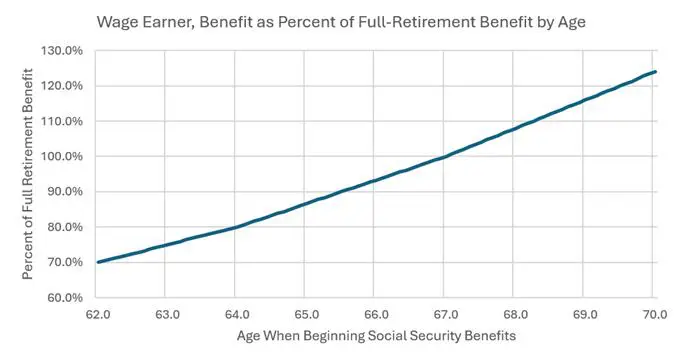
One of the questions we often hear from clients approaching retirement is when to begin taking social security. In simple terms, the earliest age you can begin to receive a benefit as the wage-earner is 62 years old, you receive your full retirement benefit at age 67 and delaying any additional time beyond 67 up to age 70 increases your monthly benefit, though benefit increases stop after age 70.
Should I start collecting Social Security early or delay, if I can?
For those born in 1960 or later, the reduction in benefit for the wage-earner is 30% off the full-retirement benefit if one were to begin collecting at age 62 and delaying beyond full-retirement age (normally 67 years old) to age 70 increases the benefit to 124% of the full retirement benefit, as illustrated in the chart below.
Decision Factors – Life Expectancy and Record of Earnings
Life expectancy is one key factor in the mathematical advantage of delaying social security income, with the calculation resulting in a “break even” life expectancy of around 78 to 79 years old for the tradeoff between collecting early at 62 versus the higher benefit starting at full retirement age of 67, or, break-even at around age 80 to 82 years old for the tradeoff between collecting at full retirement age of 67 and delaying to 70 years old for even higher income benefit. Although 2025 data1 finds Lancaster County’s average life expectancy to be 78.8 years old and Berks County’s 77.8 years old, each individual must consider their own expectations as to whether the total benefit received over the years of delayed but higher social security income exceeds the additional years collecting at lower annual benefit by collecting early.
Break-even age is a useful starting point—but it isn’t the whole decision. In addition to life expectancy, your earnings record and any impact to your earnings record from delaying is also a consideration. Because Social Security uses your highest 35 years of earnings indexed for inflation, someone who retires before accumulating 35 years of earnings—or who has relatively low-earning years earlier in their career—may see their benefit affected by additional years with little or no earnings. While individuals with long, consistent working careers may not see an impact, this factor should be reviewed and considered in consult with an advisor on the decision. You can access your earnings record and projected benefit by creating or logging into your “my Social Security” account at: https://www.ssa.gov/myaccount/.
For Married Couples, Think Beyond Your Own Benefit
Social security allows lower-earning spouses to collect up to 50% of the other partner’s full retirement benefit, and then allows the surviving spouse to continue collecting the higher of the two benefits after one spouse passes. As a result, coordinating benefits and choosing when to start collecting social security is a decision that extends beyond an individual’s own life, when married.
As with any financial planning decision, the best Social Security claiming strategy depends on your individual circumstances, goals, and overall retirement income plan. Health and longevity, marital status, earnings history, taxes, investment assets, and the need for income today can all influence the decision. There isn’t one “right” age for everyone. The right answer is the one that fits into your broader retirement plan. If you’re approaching Social Security and aren’t sure when to begin, a conversation can be a helpful place to start. At Blue Chip Financial, we can help you evaluate Social Security alongside your other sources of retirement income and develop a plan for the years ahead.
1University of Wisconsin Population Health Institute. (2026, 08 18). Pennsylvania Data and Resources. Retrieved from County Health Rankings: https://www.countyhealthrankings.org/health-data/pennsylvania/data-and-resources